

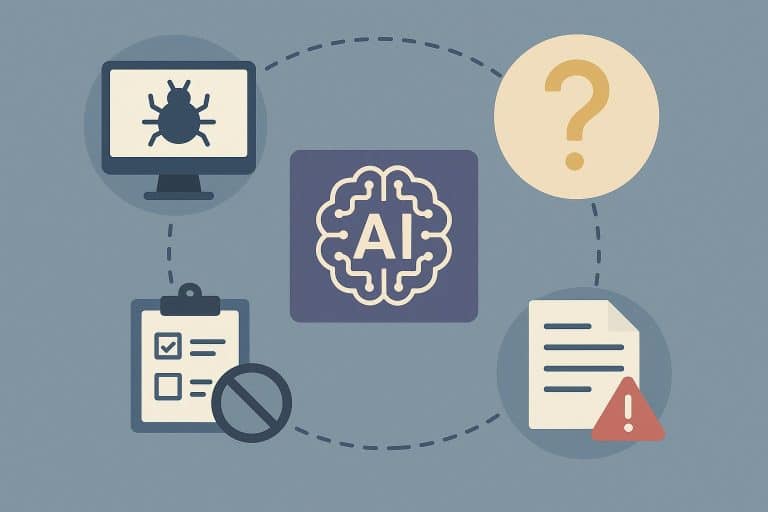
Generative AI has quickly become part of modern software testing workflows. QA teams use AI-powered tools to generate test cases, create test data, write automation scripts, analyze defects, and even review application requirements. While these capabilities can improve productivity and reduce repetitive work, they also introduce new challenges that many organizations underestimate.
The promise of faster testing and increased coverage often overshadows the limitations of AI-generated outputs. Without proper oversight, QA teams may unknowingly introduce risks that impact product quality, test reliability, and release confidence.
This article explores some of the most common challenges QA teams face when incorporating generative AI into their testing processes.
Contents
Hallucinated Test Cases and Incorrect Outputs
One of the most well-known limitations of generative AI is hallucination. AI models can confidently generate information that appears accurate but is actually incorrect or entirely fabricated.
In a QA context, hallucinations can appear in several ways:
- Test cases based on requirements that do not exist
- Incorrect assumptions about application behavior
- Invalid automation scripts
- Non-existent API endpoints or parameters
- Fabricated edge conditions
Because the generated content often looks professional and logically structured, teams may mistakenly trust it without proper validation. This creates a risk of investing time in testing scenarios that provide little value while overlooking actual business requirements.
QA professionals must treat AI-generated artifacts as drafts that require review rather than authoritative sources of truth.
Missing Critical Edge Cases
AI models are generally trained to identify common patterns and expected user behaviors. While this makes them useful for generating baseline test coverage, they often struggle to identify uncommon or business-specific edge cases.
Examples include:
- Rare user workflows
- Industry-specific compliance scenarios
- Complex permission combinations
- Localization issues
- Unusual data boundary conditions
- Multi-system integration failures
Many software defects emerge from these less obvious scenarios rather than standard user journeys. If teams rely too heavily on AI-generated test cases, they may achieve broad coverage while still missing the conditions most likely to cause production failures.
Human testers remain essential because they can apply domain expertise, critical thinking, and contextual understanding that AI models often lack.
The False Confidence Problem
Perhaps the most dangerous challenge associated with generative AI is the false sense of confidence it can create.
When AI produces hundreds of test cases, detailed reports, or comprehensive-looking automation scripts within seconds, teams may assume that quality has improved simply because more artifacts exist. In reality, quantity does not necessarily translate into meaningful coverage.
AI-generated outputs can create the illusion that:
- Requirements have been fully tested
- Risk areas have been identified
- Test coverage is complete
- Automation scripts are reliable
- Release readiness has been verified
This false confidence becomes particularly risky when organizations reduce human review in favor of automated AI-driven workflows.
Large language models such as Claude can be extremely helpful for generating test ideas, analyzing requirements, and accelerating documentation tasks. However, as discussed in this guide on Claude for QA Engineers, these tools can still miss critical edge cases, misunderstand business context, or confidently generate inaccurate outputs. Their responses often appear convincing, which can make it difficult to spot mistakes without careful review.
For QA teams, the danger isn’t that AI makes errors. It’s those errors that can be hidden behind polished, well-structured answers that create the impression of thoroughness. Understanding both the use cases and limitations of AI-assisted testing is essential for avoiding blind spots and maintaining confidence in test quality.
The most effective QA teams treat AI as an assistant rather than a replacement for human judgment. Verification, exploratory testing, risk analysis, and business-context validation remain critical responsibilities that cannot be fully delegated to generative models.
Quality of Input Determines Quality of Output
Generative AI depends heavily on the quality of the information it receives. Poorly written requirements, incomplete user stories, or ambiguous acceptance criteria often result in equally flawed AI-generated outputs.
For example, if requirements omit important business rules, AI-generated test cases will likely miss them as well. The model can only work with the context provided.
As a result, organizations must focus on improving requirement quality and documentation practices before expecting AI tools to consistently deliver valuable testing assets.
A strong testing foundation remains essential regardless of how advanced AI technology becomes.
Difficulty Understanding Business Context
While AI models can process large amounts of information, they often struggle to fully understand organizational context.
Business priorities, customer expectations, regulatory obligations, and historical production issues frequently influence testing decisions. Human QA professionals naturally incorporate these factors into their testing strategies.
Generative AI, however, may not recognize:
- Revenue-critical user flows
- High-risk customer segments
- Historical defect patterns
- Regulatory concerns
- Company-specific workflows
Without this context, AI-generated recommendations may appear reasonable while overlooking areas that deserve the greatest testing attention.
Security and Data Privacy Concerns
Many organizations are also concerned about how AI tools handle sensitive information.
Testing often involves:
- Customer data
- Financial information
- Internal business processes
- Proprietary application logic
- Product roadmaps
Submitting this information to external AI systems may create compliance, privacy, or security risks depending on organizational policies and regulatory requirements.
Before adopting generative AI tools, QA teams should work closely with security and compliance stakeholders to establish clear governance policies regarding data usage and model access.
Keeping Up With Rapidly Evolving AI Capabilities
The AI landscape continues to evolve at an extraordinary pace. New models, testing tools, and automation platforms emerge regularly, making it difficult for QA teams to stay informed.
Understanding how AI impacts software testing is important, but it’s equally valuable to understand how AI is transforming other industries and business functions. Resources such as NeuroBits AI provide broader insights into AI developments, helping professionals stay informed about emerging trends, opportunities, and challenges across multiple domains.
Expanding AI knowledge beyond testing can help QA leaders make more informed technology decisions and better prepare their organizations for future changes.
Finding the Right Balance Between AI and Human Expertise
The most successful QA teams are not replacing testers with AI. Instead, they are finding ways to combine AI efficiency with human expertise.
AI can help accelerate:
- Test case generation
- Documentation creation
- Test data preparation
- Automation script development
- Defect summarization
Meanwhile, human testers continue to provide:
- Critical thinking
- Exploratory testing
- Risk assessment
- Business understanding
- Strategic decision-making
This balanced approach allows organizations to benefit from AI-driven productivity improvements without sacrificing quality assurance standards.
Conclusion
Generative AI offers significant opportunities for QA teams, but it also introduces challenges that cannot be ignored. Hallucinations, missing edge cases, false confidence, context limitations, and security concerns all require careful management.
Organizations that view AI as a powerful assistant rather than a complete replacement for human expertise are more likely to achieve sustainable success. By combining AI capabilities with experienced QA professionals, teams can improve efficiency while maintaining the thoroughness and critical thinking necessary for delivering high-quality software.
