

Donato Marinelli is a real estate investor and philanthropist based in Franklin Lakes, New Jersey, recognized for turning underutilized properties into attractive, functional spaces that support neighborhood development. Donato Marinelli has built his career on finding value in real estate while also supporting a wide range of medical and community causes, including the American Cancer Society, the American Childhood Cancer Organization, the Advanced Breast Cancer Society, and the American Association for Cancer Research. His philanthropic reach extends to cardiovascular health as well, with support for the World Heart Federation, the American Heart Association, and the National Heart Foundation. Outside his professional and charitable work, he stays active through skiing, hiking, and travel. As a hands-on property owner, Marinelli understands that an advertised rent figure rarely tells the full story, particularly once vacancy enters the equation and changes what an owner actually collects over the course of a year.
A rental property can look profitable when expected rent appears to cover regular costs. That estimate can be incomplete because rental income means payment received for the use or occupation of property, while asking-rent data describes the amount sought for vacant units offered for rent.
Here, the property-level question is how vacancy changes rent received relative to ongoing property expenses. Tax reporting and mortgage qualification are separate reviews.
Vacancy generally means a housing unit has no one living in it when counted, unless its occupants are only temporarily absent. For market analysis, the rental vacancy rate measures the share of rental inventory that is vacant for rent.
Census also classifies a unit as vacant when it has already been rented, but the new renters have not moved in, although that is a separate vacancy status from a unit that remains vacant for rent.
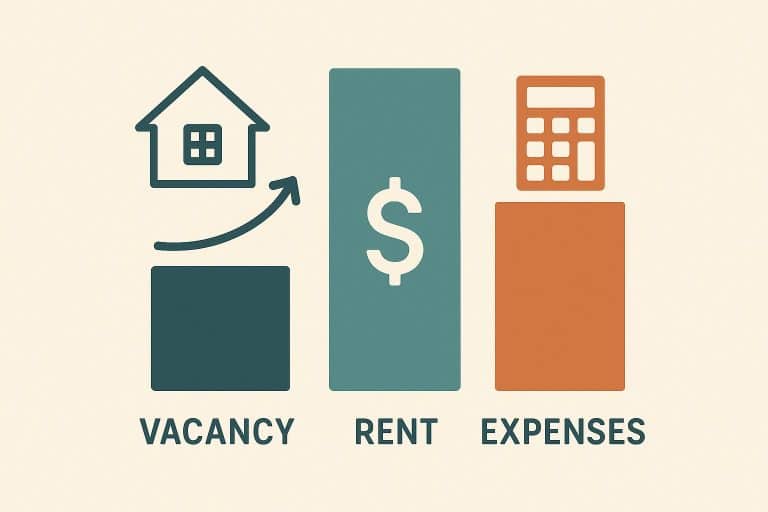
Monthly rent can make the income side look simpler than it is. A unit asking $2,000 per month appears to produce $24,000 in one year only if the owner receives rent for all twelve months.
If one month produces no rent, the owner receives $22,000 before subtracting any rental expense. The expense side requires a separate review from the rent line.
Property cash obligations may include mortgage principal and interest, taxes, and insurance, while rental records may also include repairs, maintenance, utilities, advertising, and other ordinary property expenses. These categories do not all receive the same accounting or tax treatment.
The practical point is that vacancy reduces rent received while the review still has to account for documented property expenses and obligations.
Vacancy is also measured at the market level. Federal housing data reports national vacancy rates, and quarterly updates track the rental vacancy rate as the share of rental inventory that is vacant for rent.
Those statistics measure conditions across the rental market, while an individual property’s actual vacant periods still depend on its own occupancy and rental records. The key difference is expected rent versus usable rental income.
Expected rent shows what the property could earn under the rent assumption used in the review. Certain mortgage rental-income calculations may use market rents or lease agreements and then reduce gross monthly rent to 75 percent.
The calculation treats the remaining 25 percent as absorbed by vacancy losses and ongoing maintenance before the income counts in the review. Reserves should stay separate from rent, not treated as rent received.
Rental-income rules also point reviewers to separate minimum reserve requirements, and loan-quality review may flag insufficient assets or incomplete asset documentation. That distinction keeps asset support separate from the income calculation.
Vacancy can also matter in financing review when a borrower uses rental income to qualify. The lender has to establish that the income is eligible, obtain the applicable rental documentation, and use the required calculation method.
Fannie Mae’s loan-quality reviews identify both incorrect rental-income calculations and undocumented rental income or loss as significant defects, with missing leases, tax returns, or required rental history among the possible causes.
A rental review should account for vacancy before the owner relies on a full-year rent figure. At the property level, the owner can compare rent actually received with vacant periods and ongoing property expenses rather than assuming every month produces income.
If rental income will also be used for mortgage qualification, Fannie Mae documentation, qualifying-income calculations, and reserve requirements belong to a separate financing review. Keeping those tests separate prevents vacancy from being hidden inside an optimistic rent assumption without treating borrower reserve requirements as property expenses.
About Donato Marinelli
Donato Marinelli is a real estate investor and community philanthropist based in Franklin Lakes, New Jersey, known for turning underutilized properties into attractive, functional spaces that contribute to neighborhood development. He supports numerous medical research and community organizations, including the American Cancer Society, the American Childhood Cancer Organization, and several cardiovascular health groups such as the American Heart Association and the World Heart Federation. Marinelli also devotes time to encouraging younger generations, and he enjoys skiing, hiking, and travel in his free time.
